 September 9, 2026
 6mins
Owning a home service business isn't easy. Whether you're a solo operator or running a multi-truck crew, few things matter more to your bottom line than knowing how to squeeze the most out of every marketing dollar.
The problem is, today's landscape gives you more places to spend that dollar than ever before. Google Ads, LSA, Meta, SEO, GBP, Youtube, Programmatic, etc. The options keep stacking up, and none of them come with a clear sign telling you which one is actually right for your business.
Most owners look at what's "working" for a competitor down the street and try to copy it. Unless that competitor is in your exact market, running your exact services, at your exact operational capacity, you might as well light your ad spend on fire.
Simply put, where your marketing dollars should go comes down to what stage your business is in.
Sequencing Over Budget Size
The right thing at the wrong time is still the wrong thing to do. Marketing and advertising punish bad sequencing more than almost anything else.
A home service business might start by running paid ads. But the foundation underneath it, the website, no reviews, incomplete Google Business Profile, is leaking. Instead of diagnosing the real issue, the advertising channel is labeled as “ineffective”.
No amount of budget will solve a bad foundation.
The Foundation Every Home Service Business Needs First
It’s key not to skip the foundation because every paid channel you add later performs better once these are actually in place.
Google Business Profile
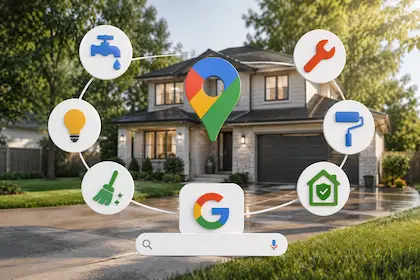
Of every free asset available to a home service business, this is the one that matters most — and the one most owners never finish setting up.
A fully built-out profile is what earns you a spot in the local map pack. It's also part of what feeds AI-driven search results now. And before a homeowner ever dials your number, there's a good chance they've already looked at this page.
A half-finished profile costs you more than ranking position. To a homeowner scanning it, missing details read as "this business might not really be running anymore." The fix is not difficult and the payoff keeps showing up.
Website (Local SEO / Service Area Pages)
Google evaluates individual pages, not entire websites. So a contractor covering six towns with a single catch-all homepage is going head-to-head against competitors who each built out a dedicated page per town.
That doesn't mean cranking out near-duplicate pages with one swapped city name and the same recycled paragraph. It means building one genuinely useful page per service area. This would include local detail, real specifics, all linked together so both Google and the visitor can see the full picture.
Eventually, these service pages can become the cheapest source of leads you'll find anywhere. Like most things that compound, the tradeoff is you have to plant it before you actually need the return.
High-Intent Channels That Drive Leads Fast
Once the proper foundation is built, this is where you start buying attention instead of earning it for free.
The key about both of these high-intent channels is the homeowner already knows they need what you sell. You're not creating demand, you're catching it at the exact moment it exists.
Google Local Service Ads
Local service ads put you at the very top of the results, above the paid search ads, and carry the Google Verified badge. You're not paying per click here, you're paying per lead, and only for the ones Google counts as valid.
This structure has made LSA one of the best places for home services to start with paid advertising.
Google is making major shifts to Local Service Ads right now, and it's worth understanding before you spend your first advertising dollar here. We broke down exactly what's changing and how it can affect home services in our breakdown of the Google LSA update.
Google Search Ads (PPC)
Google Search Ads drives real volume for home service businesses. While these PPC (pay-per-click) ads give you more control, they're also unforgiving when the setup is sloppy or the math doesn't hold.
Here is the math formula:
Average Revenue Per Job x Margin = Gross Profit Per Job
Decide what you're willing to spend to land one new customer, your target CAC.
Target CAC × Lead-to-Sale Close Rate = Max CPL
If the going cost per click in your market, combined with how well your landing page actually converts, keeps you under that number, Google PPC is worth running. If it doesn't, you're handing Google a check for money you don’t have.
A few keys that separate high-performing PPC ads and ones just burn budget:
- Fill in every asset Google gives you. Headlines, descriptions, callouts, sitelinks, your business name, your logo, call extensions, etc.
- Talk to the homeowner, not about the business. Someone searching has a problem right now. Ad copy built around "you" and "your" (your furnace, your leak, your roof) reads as speaking to their actual situation. Copy built around "we" reads as a company talking about itself.
- Let the ad name the city the searcher is actually in. Dynamic location insertion pulls the searcher's real city into the headline automatically. Familiarity reads as trust before they've clicked anything.
Ad Channel That Creates Homeowner Demand Before They Search
Meta Ads (Facebook and Instagram) work differently than search. This is interruption advertising, not intent-based advertising.
Nobody clicking a Facebook or Instagram ad was searching for what you sell. They were mid-scroll. You're not answering a question they asked, you're interrupting them with one they may not be thinking about yet.
That changes everything about what has to happen for the ad channel to work. The creative has to earn attention on its own, and the page it sends someone to has to close the gap between "I wasn't looking for this" and "I'm ready to give you my information."
Retargeting is a strong use of Meta spend once you have real site traffic to work with. But it isn't a requirement for Meta to work.
Before-and-after project photos and videos perform especially well for Meta since the transformation itself is the hook and builds trust.
Channels Worth Exploring Once You’re Profitable
They belong after the foundation and entry ad channels are already working not as a replacement for them.
YouTube
Video builds trust faster than almost any other format available to a home service business. A homeowner who's already watched you explain why water heaters fail, or walked through a real job on a real roof, feels like they know you before they ever pick up the phone.
There's a second reason this matters more than it used to. YouTube citations inside Google's AI Overviews grew over 25% in a single stretch in early 2025. A library of straightforward how-to videos isn't just a trust-builder anymore. It's becoming a real lever for whether AI-generated answers mention your business at all.
AI Answer Engine Optimization
Homeowners are increasingly asking ChatGPT, Gemini, and Google's AI-powered search results who to call before they ever scroll through a traditional list of results. A business with thin content, inconsistent listings, and few reviews is far less likely to get surfaced here, no matter what else is spent on paid ads.
Google's own guidance on this is less dramatic than a lot of the hype around it. The fundamentals that have always mattered for SEO, being crawlable, accurate, and genuinely useful, are the same fundamentals that get a business cited in an AI-generated answer.
Final Home Service Marketing Thoughts
There's no universal answer for where a home service business should spend its next marketing dollar. The only right answer is based on what stage the business is actually in.
Get the foundation built. Add the high-intent channels once it holds. Layer in the channels that drive brand awareness and create demand.
There will always be something new but the home service businesses that are winning become relentless in their sequencing not chasing the next flashy thing.
If you’re ready to build a proper foundation, add advertising channels in the right sequence, and truly grow your home service business, connect with Blank Museum today!

Austin Werner
Founder of Blank MuseumAustin is a Sacramento-based founder with nearly a decade of experience across creative, digital marketing, and advertising. He's now building Blank Museum to help home service businesses across the US grow.